Quick understanding
- What is the main thing to worship at Jing'an Temple?
The main hall honours a silver Shakyamuni, Mouni Hall a jade Shakyamuni, and Guanyin Hall the bodhisattva. Explore awakening, image-making and compassion as distinct themes.
- Has Jing'an Temple always been on Nanjing West Road?
The temple was located on the bank of Wusong River in its early days. It was renamed Jing'an Temple in 1008 and moved to the Nanjing West Road area in 1216. The inheritance of early temple building and the history of the current site should be understood separately.
- What kind of wishes are suitable here?
You can pray for sobriety and stability for yourself when you are busy, express peace and care for your family, and you can also express gratitude for the support in life. Your intention doesn't have to be grand, it just needs to be specific and sincere.
- Location
- No. 1686, Nanjing West Road, Jing'an, Shanghai
- Temple name clues
- Renamed Jing'an Temple in 1008
- Current site history
- Moved from the Wusong River in 1216
- Space characteristics
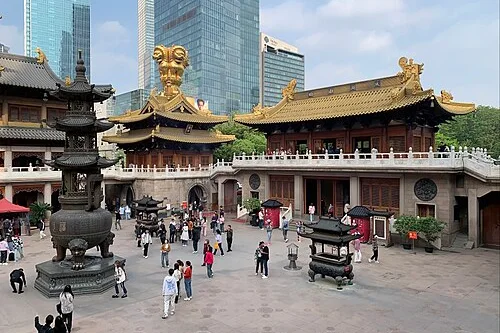
- The image of traditional wooden structure is adjacent to the modern city
In Jing'an Temple, put the things you care about
Jing'an Temple's Buddhist halls, silver and jade Buddhas and Guanyin provide a setting for expressing concerns about busy city life, loved ones and new beginnings.
Busy career direction
Write clearly the decisions you want to make and the rhythm you want to maintain.
Continue to learn →Family peace and companionship
Learn about daily care and distant concern from Guanyin compassion.
Continue to learn →Two salute traditions in Shanghai
Understand the difference between the Buddhist Jing'an Temple and the Taoist Shanghai City God Temple.
Continue to learn →Moved from the riverside to the downtown area, the location of the ancient temple also has history
The early history of Jing'an Temple can be traced back to the Three Kingdoms period. The original name was different from the current one, and the location was also on the bank of Wusong River. In the first year of Dazhong Xiangfu in the Northern Song Dynasty, the temple changed its name to Jing'an Temple; in the ninth year of Jiading in the Southern Song Dynasty, in order to avoid river erosion, it was moved to the Feijingbang area of Lupu, which is today's temple site. Understanding ancient temples, the name, location and architecture of the temple were not always formed at the same time.
The urban landscape around Nanjing West Road continued to change, but the temple remained in this area. It not only participates in the formation of place names and memories, but also maintains proximity to commerce, transportation and citizen life. When people worship Buddha here, they can also feel how Shanghai puts different levels of time into the same city.
The temple has experienced fires and restorations. Today’s wooden structures, pagodas, courtyards and retained old components each have their own construction and preservation experiences. The early origins and later buildings together form a historical layer, which not only reflects long-term respect, but also allows people to see how ancient temples have continued to enter urban life after being restored in different generations.
Follow history and understand Jing'an Temple
- 1008
Renamed Jing'an Temple
In the first year of Dazhong Xiangfu in the Northern Song Dynasty, the temple was named Jing'an Temple.
- 1216
Moved to the current location
The temple moved from the Wusong River to the Feijing Bang in Lupu, forming the historical starting point of today's Nanjing West Road temple site.
- 1972
The Main Hall was hit by fire
The fire caused damage to the main hall, which became an important turning point in the history of modern temples.
- Since the 1980s
Restoration of ancient temples and discovery of old components
During the restoration process, foundation stones with lotus patterns from the Song Dynasty were discovered, preserving important clues to ancient construction.
- Since 1998
Connecting with rail transit
The temple is spatially adjusted in the context of subway construction and continues to develop together with the modern city.
Look at the eaves and column bases: the small-scale remains behind the magnificence
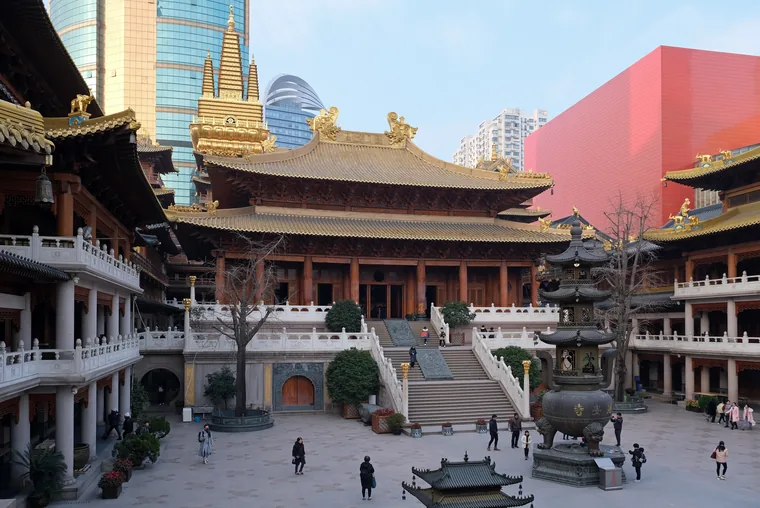
The roof, brackets, columns and Buddhist decorations of Jing'an Temple draw on the traditional wooden architectural language. The main hall is covered with copper tiles. Looking up from the courtyard, you can see the roof ridge and the shadow of the tower, and turning around, you can see modern buildings. Therefore, the space of the ancient temple has a distinct urban scale.
The Song Dynasty lotus pattern foundation stone discovered during the restoration process provides more concrete clues to history than legend. The foundation stone bears the weight of the column, and its appearance may seem inconspicuous, but it retains the patterns and scale of ancient construction. By moving your gaze from the golden eaves to the load-bearing column bases, you can understand how a building stands in more detail.
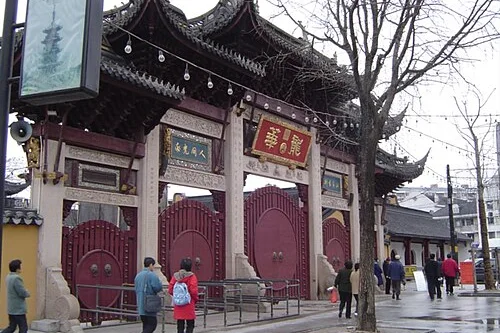
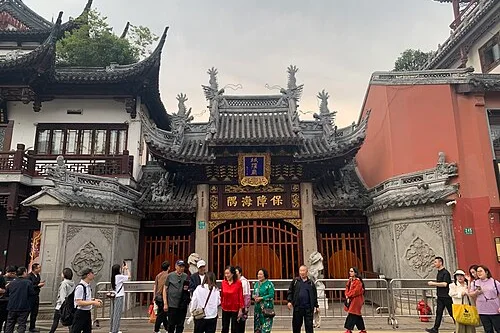
The integration of the mountain gate and the Tianwang Hall, and the connection between the Drum Tower and the subway entrance and exit also reflect the arrangement of the temple in a dense urban area. The tranquility here does not require leaving the city; leaving a place for worship, walking and pause in a limited courtyard is an important feature of this ancient temple in itself.
Silver, jade and wood, how three materials carry respect
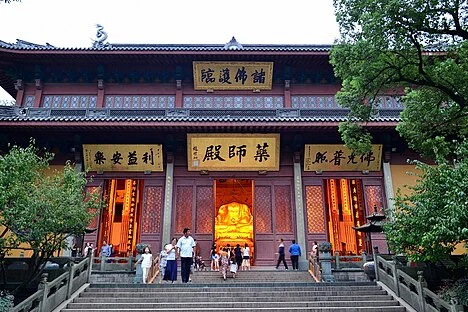
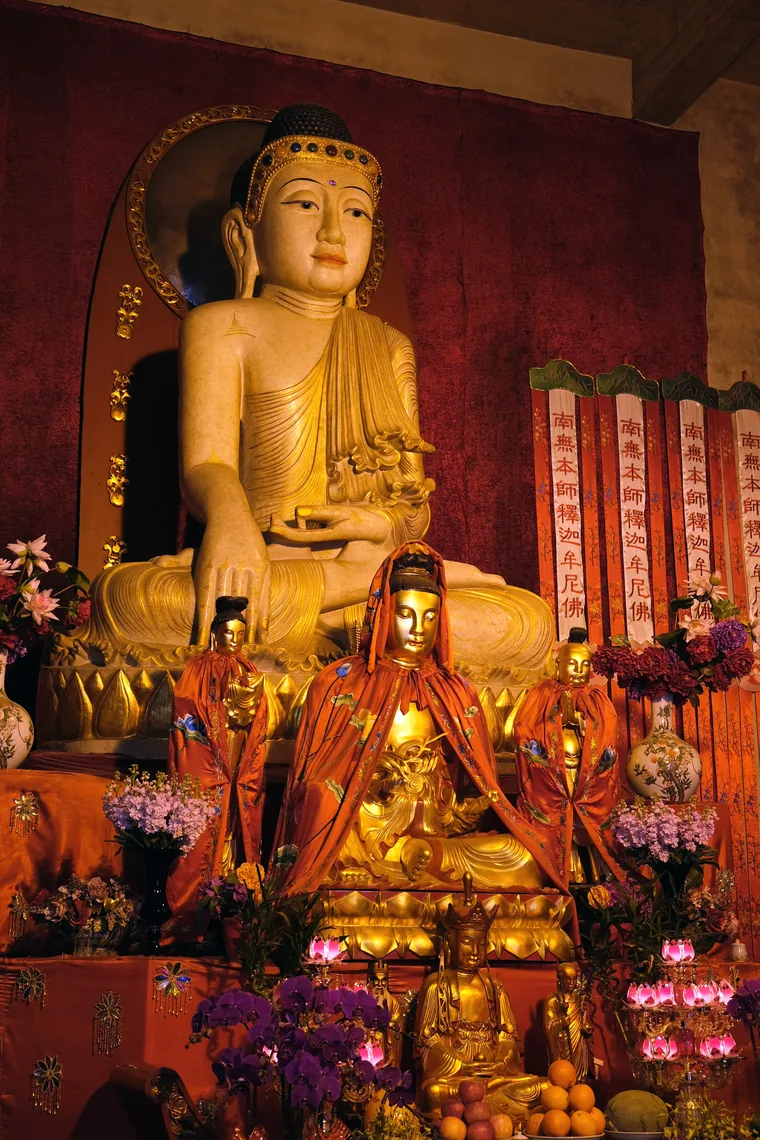
The Shakyamuni Silver Buddha in the Main Hall is an important entrance to the statues in Jing'an Temple. The luster of silver and the wooden structure of the main hall create different textures; when viewing, you can pay attention to the Buddha's face, clothing patterns and spatial scale, rather than just treating the precious materials as all of their value.
Mouni Hall's jade Buddha also represents Shakyamuni; the wooden Guanyin in Guanyin Hall presents compassion. Different materials and forms create artistic variety. Knowing the figures helps connect wishes for wisdom, steadiness or family care with a particular space.
Busy urban life makes it easy for people to constantly compare and catch up. Buddhist salutation provides a moment to sort out one's thoughts: who needs to be cared for most at this moment, what is it that one wants to keep most, and what is the one thing that can be done seriously next. Such a wish can be small, but it can also be enough to become a new starting direction.
In the rhythm of the city, leave a sense of clarity in life
Jing'an Temple is connected to the city memory of Shanghai, and it also makes many people think of stopping to sort out their thoughts in their busy lives. You can write specifically about your work direction, family relationships, or adaptation after moving: what you need to see most clearly now, how you hope to stabilize your life, and how seriously you want to take every day.
Silver and jade do not make these images different Buddhas. The main hall and Mouni Hall both present Shakyamuni in distinct artistic forms; Guanyin Hall has its own compassionate theme. Distinguish hall, material and figure.
When choosing between Jing'an Temple and Shanghai City God Temple, first distinguish Buddhist and Taoist figures, then consider family customs. For a previous wish, recall where and to whom it was expressed rather than changing locations simply because both are in Shanghai.
Understanding the halls and the figures within them
| Palace or space | Figures and cultural roles |
|---|---|
| Main Hall | Shakyamuni Buddha·Silver Buddha statue |
| Muni Hall | Shakyamuni Buddha·Emerald Buddha statue |
| Guanyin Temple | Guanyin (Avalokiteshvara) ·Wood sculpture |
Main Hall
Principal figures: Shakyamuni Buddha·Silver Buddha statue
The main hall honours Shakyamuni, with the silver image as a distinctive artistic feature.
Materials such as silver, jade or wood belong to the artistic expression of statues. First identify the objects of worship in the hall, and then observe the material and shape to better understand the Buddhist hall. The presence of the image of Shakyamuni in both the Mahavira and the Muni Hall does not mean that each of the two halls corresponds to an unrelated desire.
Associated wishes: You can express your wishes for clear judgment, family stability, and conscientious actions in daily life, and you can also express your gratitude at the end of the stage.
Muni Hall
Principal figures: Shakyamuni Buddha·Emerald Buddha statue
The Emerald Buddha in the Muni Hall also represents Shakyamuni. As an enlightened being, Buddha taught people to recognize suffering, cultivate compassion and wisdom; the title of "Muni" is connected with the name of Shakyamuni. The Emerald Buddha and the Silver Buddha in the Main Hall use different materials to present the same object of worship, so that when you get to know the statues, you can not only appreciate the art, but also attribute your mind to the same Buddhist teachings.
Jing'an Temple uses materials such as jade, silver and wood carvings to form various levels of sculptures. The Jade Buddha in the Muni Hall is suitable for reading together with the Silver Buddha in the main hall: the materials bring different light and texture, and the themes of learning, reflection and settling the body and mind are common. May your pursuit of knowledge be honest, make wise choices, and be less impatient in daily life. This can be a tribute that is close to urban life.
Associated wishes: You can wish for clear understanding and good karma for studying, changing jobs, and relocation, and also pray for physical and mental health for your family. If you are at a stage where it is difficult to adapt, you can express the support you need most. May you retain the courage to ask for help and slowly build a peaceful life.
Guanyin Temple
Principal figures: Guanyin (Avalokiteshvara) ·Wood sculpture
The name of Guanyin (Avalokiteshvara) is associated with hearing the suffering of all living beings and responding with compassion. Different images of Guanyin allow this relief and care to enter various life situations, so people often pray for the well-being of relatives and friends, safe travels, and help in difficulties. Compassion also includes understanding the needs of others, so family relationships, thoughts and gratitude can all become concrete and intimate thoughts in Guanyin worship.
Jing'an Temple Guanyin uses wood carvings and silver and jade Buddha statues to form different artistic levels. The theme of compassion also gives the urban ancient temple a close family care. When stopping for a short time, people can write down the hard work of their parents, the pressure of their partners, or the concerns of their children alone; understanding Guanyin's voice and rescuing people can allow this concern to see the other person first, and not just stay at the general peace.
Associated wishes: You can wish your family good health, a peaceful mind, and someone who understands you in times of difficulty. You can also express your gratitude to the people around you who take care of you silently. If the time difference makes it difficult to communicate, you can write down the concerns that you want to say but have not yet said, so that this tribute retains a concrete sense of companionship.
Write down the concerns in culture as your own wishes
Sobriety and rhythm in busy life
Mahavira Shakyamuni Buddha
The rhythms of work and life often intersect. Jing'an Temple's urban location and Buddhist culture can serve as a backdrop for sorting out direction, calming the mind, and cherishing the present. When expressing your wishes for your career, you can also write down what kind of judgment, cooperation and pace of life you want to maintain.
First explain the current work direction, life rhythm and things you hope to stick to. Then write down the changes you hope to happen and the actions you are willing to take seriously. You can use the example sentences below as a starting point and replace them with expressions that fit your life.
Example of wish expression
I wish to stay awake in my busy life, have direction in my work, and be sincere in my cooperation; I also wish to leave time for my family and myself to live a serious life.
Family peace and small company
Guanyin Temple Guanyin (Avalokiteshvara)
Guanyin's compassion is based on hearing the sufferings of sentient beings and responding to them as the core of the culture. Jing'an Temple wood carving Guanyin makes this kind of care a close and respectful object in the city. Physical fatigue, uneasiness in the heart, or longing due to jet lag can be solemnly expressed. Praying for the safety of your family can not only wish you good health, but also hope that your loved ones’ difficulties will be understood.
You can write down the care that your parents, partner or children need most at the moment, and wish you physical and mental stability, smooth care, and a harmonious relationship at home. If you can't be together for the time being, you can write out the greeting or thank you you want to say in full, so that the blessing carries a specific story about your loved ones, rather than just a general message of peace.
Example of wish expression
I hope that my family will be safe and be willing to speak out when they have difficulties; I also hope that I can set aside time every week to listen carefully to them talk about their current situation.
New city and easy adaptation
Shakyamuni Buddha; historical clues of the relocation of the ancient temple
The Shakyamuni presented by the Jade Buddha of Muni Temple links the teachings of enlightenment and learning; the history of Jing'an Temple's relocation, reconstruction and continuation makes the new environment and continuous inheritance become an approachable cultural association. People who arrive in a city for the first time can rely on this to increase their knowledge, stabilize their mind, and maintain values and family ties that they can rely on despite changes.
You can explain your new job, study, or relocation, and pray that you will adapt smoothly, meet trustworthy friends, and your family will be less worried. You can also write about traditions, relationships, and aspirations that you hope to continue to cherish in your new life, so that your search for stability is both future-oriented and remembering where you came from.
Example of wish expression
I hope I can gradually find a rhythm in my new life in Shanghai, be willing to ask questions when I encounter things I don’t understand, and have the patience to meet sincere people.
Thank you for your support in ordinary days
Guanyin Hall·Compassion and Care; Buddhist Hall·Reflection and Study
Guanyin Compassion reminds people to see the suffering of others, and the Buddha's teachings connect gratitude with self-reflection. Jing'an Temple's Buddhist Hall and Guanyin Hall can provide different clues for gratitude for daily support: someone who has the patience to understand difficulties, and someone who offers guidance from experience. Although such help is ordinary, it allows work, study and family life to continue in other places.
You can tell about a specific moment when you were cared for, thank your friends, colleagues or family for taking care of you, and pray that they will also feel safe and healthy. If your life has taken a turn for the better recently, you can also say what you want to cherish most now, and let your thanks include the help you received in the past and the goodwill you want to continue in the future.
Example of wish expression
Thanks to my friends for taking the initiative to help me when I was busiest. May I remember this thoughtfulness and be able to respond promptly when others need it in the future.
In the image, continue to get to know each other Jing'an Temple
Take you to know a different Jing'an Temple in 10 minutes! Jing'an Temple Why is the Ashoka Stone Pillar called the Ashoka Brahma Pillar? Why is the Jing'an Temple Vajra Throne Tower different from the towers in other temples? #Jing'an Temple # Temple #Buddhism
Combine images to understand the architecture and Buddhist culture of Jing'an Temple in Shanghai.
顿清修心 · Bilibili · in Bilibili Watch original video
The author focuses on the introduction of Jing'an Temple's Buddhist buildings, pagodas and temple buildings. The materials and spaces of urban temples can be observed in conjunction with the main text. Specific points in the commentary retain author attribution.
If playback is restricted by the network or platform, the original video entrance can be used.
Commissioned services and fees
$227 USD · Basic service fee
In an ancient temple in downtown Shanghai, convey your feelings seriously
The basic commission includes tickets, incense, Buddha worship and making wishes; pictures and video visit records correspond to the specific temple, the selected offerings and this commission, and are delivered privately.
You can also entrust your family together. It is recommended that there be no more than 3 people per order, so that you can express your feelings one by one.
A private visit record will be provided 1-2 working days after the service is completed.
Anxin is an independent commissioning team and does not represent Jing'an Temple. Basic entrustment does not automatically include initiation, consecration or special rituals. Optional offerings and special needs must be confirmed separately.
Select your wish, desired date and offerings and submit the request, then add official customer service for verification. Submission does not mean successful reservation, payment or seat reservation.
Yes Submit request and confirm with our team . There is no need to log in for consultation; the appointment has not been successful after submission.
About Jing'an Temple , you may also want to know
Is the name of Jing’an District in Shanghai related to the temple?
Jing'an Temple is an important historical landmark in this area, and Jing'an District is also named after the temple. Its local cultural influence continues among temples, neighborhoods and urban memories.
In what year was the current location of Jing'an Temple formed?
In 1216, the temple moved from the Wusong River to the Feijing Bang in Lupu, which is the area around the temple site on Nanjing West Road today; the inheritance of early temple construction is earlier than the current site.
Are the Silver Buddha and the Jade Buddha different Buddhas?
The Silver Buddha in the Main Hall and the Jade Buddha in the Muni Hall introduced on this page both represent Shakyamuni. Materials and sculptures have different expressions, which does not mean that each guarantees a realistic result.
Why are the foundation stones of the Song Dynasty worth paying attention to?
These load-bearing components under the columns preserve the lotus pattern and ancient construction scale, providing specific cultural relic clues for understanding the history of the temple. They should be understood separately from the restored buildings of later generations.
How are the ancient temple and the subway adjacent?
The temple adjusts its space in modern urban construction. The mountain gate and Tianwang Hall are integrated, and some buildings are connected with the subway entrance and exit, forming a unique temple pattern in dense urban areas.
Can I express my wishes to my family on weekdays?
You can first state the expected date, object and content of wishes, and the customer service will then check the temple arrangements and the range of visit records. Foundation commissions are distinct from specialized ceremonies held on specific dates in the temple.
How can I choose between Jing'an Temple and Shanghai City God Temple for family wishes?
Start with familiar devotional customs and specific figures: Jing'an Temple is Buddhist, while Shanghai City God Temple is Taoist. A longstanding family connection or a prior wish at either place is also relevant.
When working overseas, can I only write about promotion and salary increase as my career aspirations?
You can express this expectation, and you can also add the direction you value, the specific difficulties in your work, and how you hope to cooperate with others, so that your wishes can be closer to your actual situation.